Live Oyster Shucking for Events in Mallorca
What live oyster shucking really involves at a Mallorca event: service formats, guest interaction, rhythm, food safety and how the shucking team coordinates with your planner and main caterer.
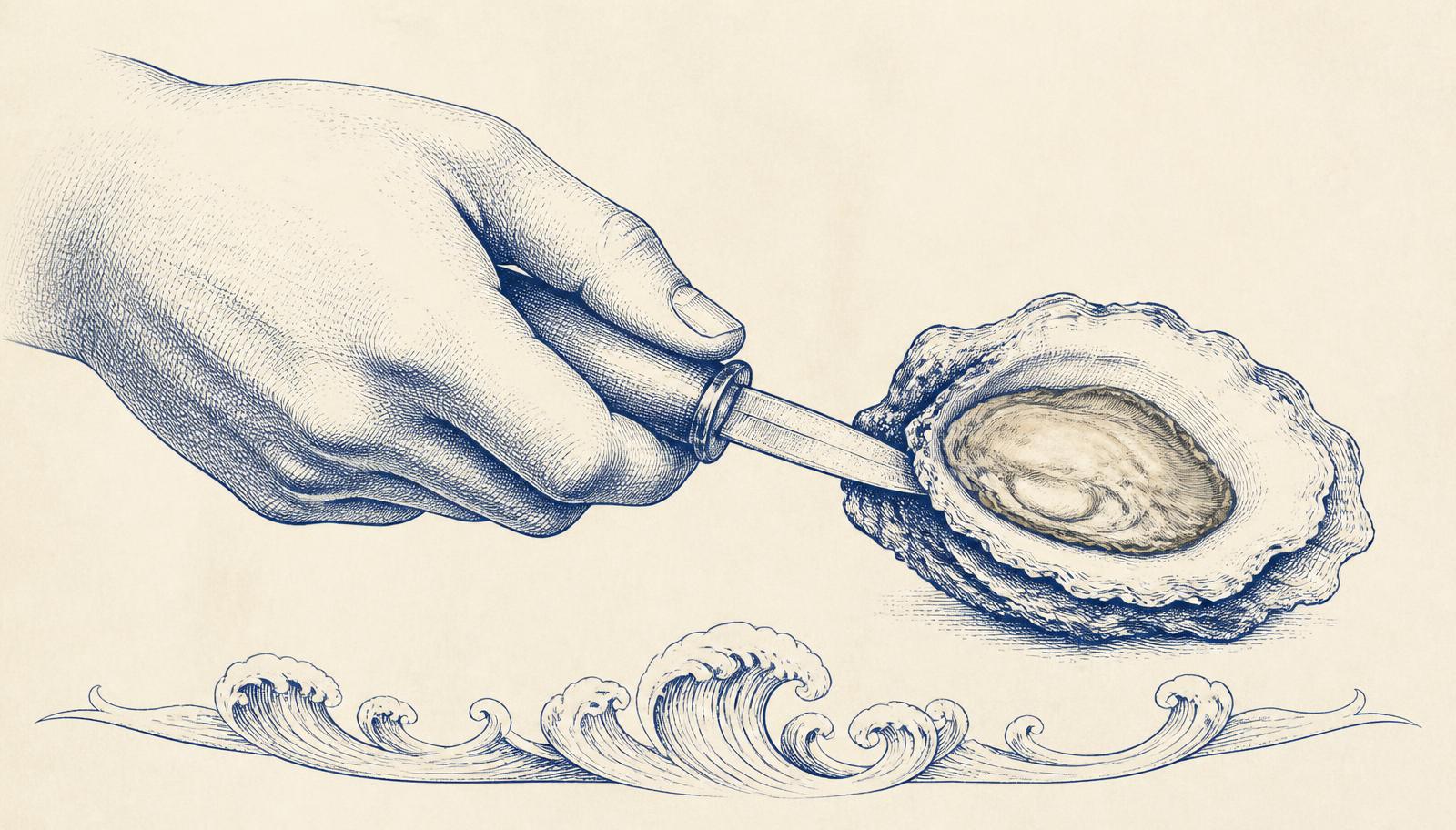
Live oyster shucking is a specialist service in which each oyster is opened by hand, inspected and served within moments of reaching the guest. Nothing is prepared and left waiting on a tray: the shell is opened in front of the person who is about to eat it. At an event in Mallorca — a villa cocktail hour above the sea, a finca dinner inland, a welcome reception before a wedding — that single decision changes the pace and the atmosphere of the whole moment.
This piece explains what actually happens at the station, why opening to order matters, which service formats exist, what makes a shucker professional rather than merely fast, and how the service is planned around your timings, your venue and your other suppliers. If you are still deciding whether a raw bar belongs in your event at all, our complete guide to oyster catering in Mallorca covers the wider picture.
What live oyster shucking actually means
Shucking is the act of opening an oyster: locating the hinge, working the knife in without shattering the shell, severing the adductor muscle cleanly and releasing the meat while keeping the natural liquor intact. Done well, it takes seconds and leaves no grit, no fragments and no spillage.
Live shucking means that step happens on site, continuously, during the service window — not in a kitchen an hour earlier. The station is set up with refrigerated storage, crushed ice, knives, gloves, cloths, a waste channel and a small, restrained set of accompaniments. Guests approach, an oyster is opened in front of them, checked, dressed if they wish and handed over.
The visible craft is part of the offer. Guests watch the shell open, hear the sound, see the liquor still moving. It is not theatre for its own sake; it is transparency, and transparency is what makes raw shellfish feel confident rather than risky.
From cold box to guest: the sequence at the station
Oysters arrive refrigerated and stay under a controlled cold chain until service, stored flat side up so they retain their liquor. They are never submerged in fresh water or left in standing meltwater.
Before opening, each oyster is handled and assessed: the shell should be intact and closed, or should close when tapped. Anything that looks or smells wrong is set aside rather than served — a judgement the shucker makes individually, oyster by oyster.
After opening, the meat is checked again in the shell: liquor clear, flesh plump and attached, no shell fragments. The oyster is then set on crushed ice and served, ideally within a very short window rather than being banked up in advance.
Between rounds the shucker keeps the working surface clean, the knives wiped, the ice replenished and the shell waste out of the guests' line of sight. Most of that work is invisible, which is exactly the point.
Why opening to order matters
An oyster begins to change the moment it is opened. Liquor evaporates or is lost, the texture softens, the aroma flattens, and the temperature drifts — particularly under Mediterranean sun. Opening close to the moment of eating protects the qualities people are actually there for: salinity, texture and clarity of flavour.
It also protects the pace of the event. A shucker working continuously feeds a moving crowd naturally: nobody is served from a tray that has been sitting out, and there is no single dramatic drop of two hundred oysters that arrives and then declines. The service is a steady rhythm rather than a spike.
No service can offer absolute guarantees about a natural, living product, and no serious supplier should claim otherwise. What live shucking offers is careful handling, individual inspection and the shortest sensible interval between opening and eating.
Service formats
A fixed station or oyster bar is the most common choice. It gives the service a visual anchor, works well in a defined cocktail area, and lets guests gather, watch and return. It suits villa terraces, garden receptions and hotel or beach club spaces where a bar-height surface can be positioned in shade.
Service among the guests keeps the oysters moving through the crowd, carried by staff equipped for it, with a shucking point held nearby so nothing travels far or waits long. This works when the space is spread out, when guests are seated in groups, or when the layout does not allow a queue to form comfortably.
A guided tasting turns the service into a short, seated or semi-seated sequence: a small number of oysters presented one after another, with a few words on origin, salinity and texture. It suits smaller private dinners and welcome evenings where the group is intimate enough to hold attention.
Combining oysters with caviar raises the register for milestone moments. The two are served alongside each other with the same restraint — small portions, correct temperature, minimal garnish. For weddings specifically, our guide to the oyster bar for weddings in Mallorca goes further into the timeline of the day.
Live shucking versus a pre-opened platter
A pre-opened platter is prepared in advance, arranged on ice and brought out complete. It is simpler to stage and it can look striking on arrival, but the eating window is fixed by the moment it was prepared, and the last guest to reach it has a very different experience from the first.
Live shucking spreads that quality evenly across the whole service window. It also allows the shucker to reject an individual oyster quietly, adjust the pace to demand, and answer questions from guests who want to know what they are eating.
The trade-off is that live shucking needs space, a working position, refrigeration arranged with the venue and a defined service window. Those are planning requirements, not obstacles — but they belong in the conversation early.
What makes a shucker professional
Technique first: a clean opening with an intact shell edge, no fragments, no torn meat and the liquor preserved. That consistency, held for an hour or more, is the difference between a trained shucker and someone who has watched a video.
Then hygiene: gloved hands, clean cloths, separated waste, a station that stays orderly, and disciplined handling of the cold chain throughout.
Then inspection: the willingness to discard. A professional sets aside anything that does not look, smell or behave as it should, without drawing attention to it.
Then rhythm: reading the room, matching output to the flow of guests, keeping a small reserve moving without opening far ahead of demand.
And finally communication: brief, warm, unhurried answers about origin and flavour, and a clear, discreet word to guests who ask about allergens or who should not be eating raw shellfish.
Where it fits in Mallorca
Coastal villas suit a shaded terrace station within reach of a service door. Inland fincas and Serra de Tramuntana properties often have beautiful but exposed positions, longer internal distances and less obvious access, so the station location and the refrigerated holding point need to be agreed rather than assumed.
Hotels and beach clubs usually have the infrastructure already, and the work becomes coordination with their operations team. Corporate events and product launches use the format well, because a shucking station gives people a reason to gather and a subject to talk about.
Yacht and marina celebrations are possible but sit under real operational conditions: available deck space, a safe working surface, access at the quay, waste handling and weather. These are assessed case by case rather than promised in advance.
The broader service context for private properties is covered on our villa event catering page, and the shucking service itself sits within our oyster catering in Mallorca offer.
Timing and coordination
The strongest placement is the welcome or cocktail hour, when guests are standing, moving and ready to eat something light. A sunset reception works for the same reason, with the added benefit of falling temperatures. A defined pass before a seated dinner also works, provided the window is agreed with the chef so it does not collide with the first course.
Planning starts from three numbers: guest count, service duration and what else is being served. A raw bar running alongside a full canapé programme plays a different role from one that carries the entire arrival hour, and the quantities and staffing follow from that.
Coordination with the planner, the venue and the main caterer covers arrival and setup times, the station position, refrigerated space, ice, power and lighting if the service runs into the evening, and waste removal at the end. Agreeing these in advance is what keeps the service invisible in the best sense.
Venue checklist
Space for a working station with room for guests to gather without blocking circulation. Shade, or a position that will be shaded during the service window. Refrigerated holding space agreed with the venue. A reliable ice supply. Access to water and hand hygiene. A practical route from the delivery point to the station without carrying product through the guest area. Lighting if service continues after dark. A defined place for shell waste and its removal. And a weather plan: an alternative shaded or covered position identified before the day.
Food safety and guest care
Raw shellfish demands discipline: an unbroken cold chain, traceability of the product received, opening close to consumption, no direct sun on the display, and ice replenished as it melts.
Molluscs are a declarable allergen and the service should be able to say so clearly, both at the station and in advance to the planner. Guests who are pregnant, immunocompromised or otherwise vulnerable are generally advised to avoid raw shellfish; that guidance should be available discreetly rather than announced.
Heat is the main environmental variable in Mallorca. Position, shade and ice management do most of the work, and the service window should be planned around the hottest part of the day rather than through it.
Requesting a proposal
The more precise the brief, the more useful the proposal. Share the date, the venue or area, the approximate guest count, the moment you want the service to occupy and its duration, whether there is shade and refrigerated space, who the planner and main caterer are, and whether you would like caviar alongside the oysters.
The Seventh Oyster is not a general catering company. It is a specialised oyster and caviar experience, prepared and served live, built around a single well-executed moment within your event. Tell us about your event and we will shape a proposal around it.
Frequently asked questions
- What is live oyster shucking?
- It is a service where oysters are opened by hand on site, inspected and served immediately, rather than being prepared in advance and set out on a tray. The opening happens in front of the guest during the service window.
- Is live shucking better than a pre-opened oyster platter?
- For an event that runs over an hour or more, yes. A pre-opened platter is at its best in its first minutes; live shucking keeps the same standard for every guest across the whole service window and allows each oyster to be inspected individually.
- How many oysters should I plan per guest?
- It depends on the guest count, the length of the service and what else is on the menu. A raw bar carrying an entire arrival hour needs a different plan from one served alongside a full canapé programme, which is why we build quantities from your specific timeline.
- What does the venue need to provide?
- In practice: a shaded position with space for a working station, refrigerated holding space agreed in advance, an ice supply, access to water and hand hygiene, a sensible delivery route, lighting if the service runs into the evening, and a place for shell waste.
- Can live shucking work on a yacht?
- It can, subject to operational conditions: usable deck space, a safe working surface, access at the quay, waste handling and weather. We assess each yacht and marina individually rather than assuming it will work.
- Are oysters safe to serve at an outdoor summer event in Mallorca?
- With a controlled cold chain, a shaded position, individual inspection at opening, ice replenished as it melts and a service window planned around the heat, raw shellfish can be served responsibly outdoors. No supplier can offer absolute guarantees with a natural product, which is why handling discipline matters.
- Should any guests avoid raw oysters?
- Molluscs are a declarable allergen, and guests who are pregnant, immunocompromised or otherwise vulnerable are generally advised not to eat raw shellfish. We make that information available discreetly at the station and to your planner beforehand.
- Can the oysters be served with caviar?
- Yes. Oysters and caviar are often served alongside each other for milestone moments, with the same restraint in portioning, temperature and garnish. It is arranged as part of the same service rather than as a separate supplier.
Planning an oyster experience in Mallorca
The Seventh Oyster creates tailored oyster and caviar experiences for weddings, private villas and celebrations, coordinating directly with planners, venues and main caterers. Share the date, the location, an approximate guest count and the concept — we will build a proposal shaped around it.