Oyster Catering for Yacht Events and Private Celebrations in Mallorca
How oyster catering works on board: space, refrigeration, crew coordination, guest flow, timing and weather contingencies for yacht events and private celebrations in Mallorca.
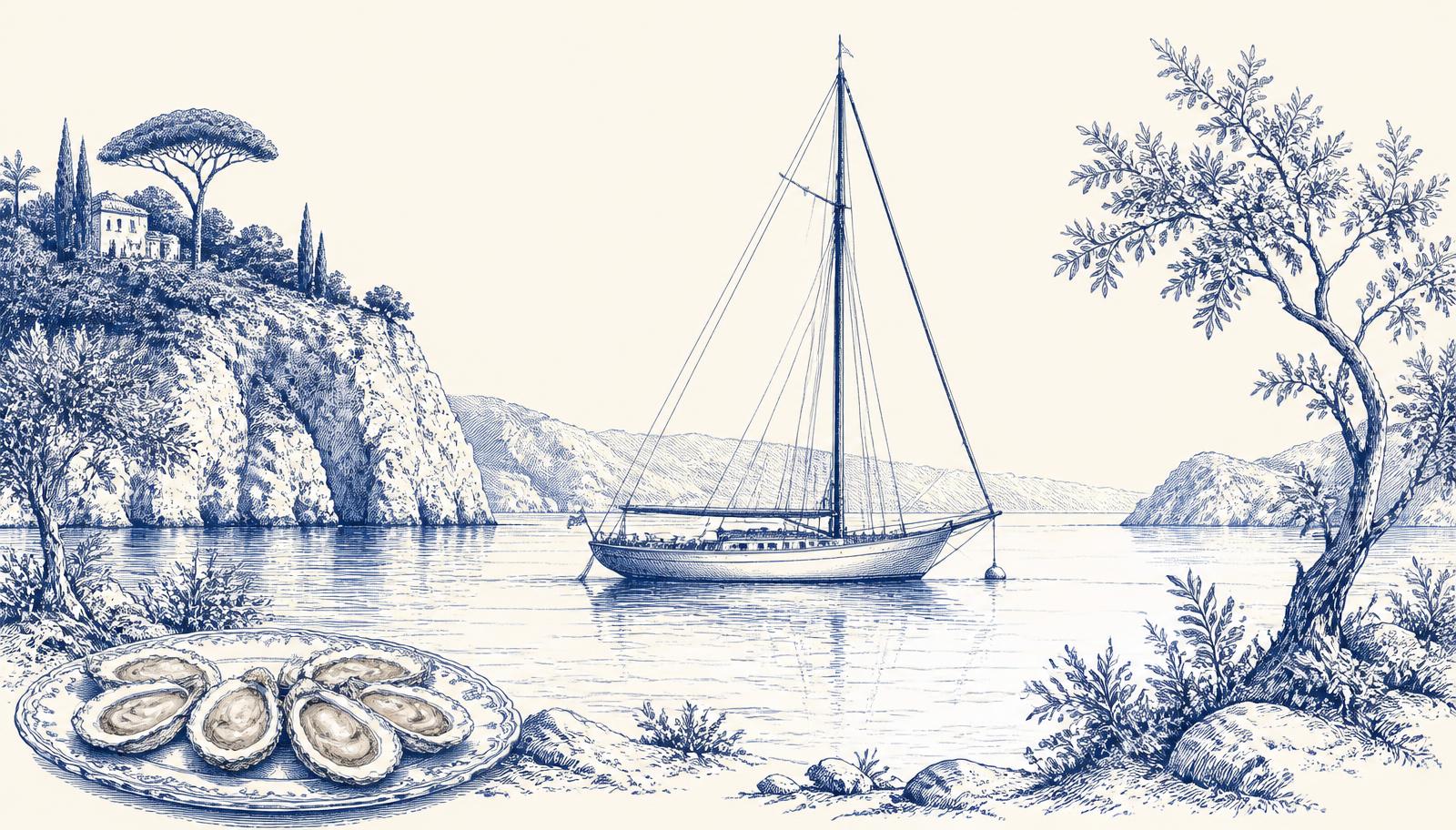
Oyster catering on a yacht in Mallorca is possible when four conditions are met: a stable and protected working surface for the knife, refrigerated holding agreed with the crew, a service position that never obstructs passages, controls or crew routes, and a weather and sea-state plan signed off by the captain. Everything else — the format, the timing, the sequence with caviar — follows from those four, and none of them can be confirmed before the specific vessel and berth have been assessed.
This guide is written for charter guests, hosts, planners and crew organising a welcome-aboard reception, an early charter day, a pre-wedding sea day, a birthday or a private celebration on the water. It covers what changes between land and deck, which service formats survive onboard conditions, and where the honest answer is to adapt the format or decline it. If you are still at the stage of understanding the service itself, start with our complete guide to oyster catering in Mallorca.
Why oysters belong at a celebration on the water
An oyster course asks very little of a setting and gives a great deal back. It needs no cooking, no plating line, no heat and no long service chain. It arrives cold, it is opened in front of the guest, and it is eaten within seconds. On a deck at anchor, with the light dropping over the bay, that immediacy reads as generosity rather than spectacle.
There is also a practical logic. Yacht galleys are small and already committed to the rest of the day. A specialist oyster and caviar service sits outside that pressure: it brings its own product, its own cold chain, its own tools and its own hands, and it occupies a defined position for a defined window. Done properly, it adds a memorable course without adding load to the crew or the yacht chef.
What it should never become is a performance imposed on a working vessel. The yacht is a boat before it is a venue, and the service has to respect that order.
Yacht versus land: what actually changes
On land, an oyster station is a fixed point in an open space. On board, almost every assumption behind that station has to be re-examined.
Movement is the first difference. Even alongside in a marina, wash from passing traffic moves the deck. A knife entering a shell needs a surface that does not shift under load, and a shucker who is braced rather than balancing. Underway or in swell, that condition frequently disappears.
Space is the second. Service corridors on a yacht are narrow, and they are shared with crew carrying drinks, guests moving between decks, and equipment that must remain reachable. A station that would be modest ashore can be an obstruction on a passerelle-side deck.
Storage and drainage are the third. Refrigerated space is limited and already allocated. Melting ice produces water, and water on a deck is a slip risk as well as a housekeeping problem. Waste and empty shells accumulate quickly and have nowhere to go unless the route off the vessel has been agreed in advance.
Finally, access. Loading a cold-chain service down a marina pontoon, across a passerelle and up an internal stair is a different operation from wheeling a case across a villa terrace. It has to be planned with the crew, not improvised on the day.
Service formats that work on board
Every format below is subject to assessment of the specific vessel, berth and conditions. None of them is a promise made before that assessment.
A compact fixed station is the closest equivalent to the land format: a small, secured worktop with ice, opening in view of the guests. It suits alongside berths and larger aft decks where a defined position can be held without narrowing circulation.
A nearby preparation point with tray service separates the knife from the crowd. Opening happens at a stable, protected surface — often in a sheltered corner or in a space agreed with the crew — and the oysters travel to guests on trays. This is usually the most robust option on smaller vessels and the one that keeps passages clear.
A guided tasting suits small groups: eight to twelve guests seated or standing around a single point, with a short explanation of the oysters served in a deliberate order. It works well on a sea day where time is not compressed.
An oysters-and-caviar sequence adds a second act to the same moment, with the caviar served immediately after the oysters rather than alongside them. The reasoning behind pairing the two is set out in our article on luxury seafood catering in Mallorca.
Timing: when the oysters should appear
The welcome aboard at the berth is the most reliable window. The vessel is still, the crew is not manoeuvring, guests arrive in a natural sequence, and the service can be struck before departure.
Early in a charter, once the yacht has settled at anchor, is the second good window. Conditions are usually calmest, the sun is not yet at its hardest, and the oysters open the day rather than competing with lunch.
A sunset aperitif at anchor is the most atmospheric and the most weather-dependent. It should be planned with an explicit alternative.
A short pre-dinner pass — a single round of oysters served before the main meal — works when the yacht chef or main caterer is running the rest of the food and wants a defined, contained course.
In every case the service must avoid manoeuvres, tender operations, anchoring, docking and crew handovers. Those moments belong to the crew, and no food service should compete with them.
Live shucking, and when it has to stop
Live oyster shucking on a yacht is only appropriate on a stable, protected working surface. The knife requires controlled force in a precise direction; a deck that lifts or rolls turns that into an unnecessary risk for the person holding it.
If movement, swell, wind or spray make knife work unsafe, the correct responses, in order, are to adapt — move the opening point to a sheltered, stable position — to pause until conditions settle, or to decline that element of the service entirely. Declining is not a failure of the service; it is the service working as intended. The craft itself is described in more detail in live oyster shucking for events in Mallorca.
Where opening in front of guests is not viable, the alternative is a nearby protected preparation point with tray service, which preserves freshness while removing the knife from an unstable position.
Cold chain, ice and refrigeration on board
The product arrives under a controlled cold chain and stays under one. On board, that means refrigerated or insulated holding in a space agreed with the crew in advance — never an assumption that fridge capacity will be available on arrival.
Ice is managed rather than simply supplied. It is replenished through the service window, the display is rebuilt as it settles, and meltwater is drained or collected so it never stands on the presentation or on the deck. Direct sun on the ice bed shortens everything: shade, whether from an awning, a bimini or the position itself, is part of the plan.
Service windows on the water are deliberately contained. A shorter, well-supplied window produces better oysters than a long one held together by improvisation.
Safety, traceability and honest limits
Oysters come from authorised supply with traceable batches. Every oyster is inspected individually as it is opened, and anything that does not look or smell right is discarded without discussion. Opening happens close to consumption rather than in advance.
Oysters are a mollusc allergen and this is communicated clearly at the point of service. Guests who are pregnant, immunocompromised or otherwise vulnerable are given prudent guidance and an alternative rather than encouragement. No supplier can offer an absolute guarantee about raw seafood; what can be offered is method, and the discipline to apply it in less forgiving conditions. For background, see EFSA — food allergens.
Access and loading: the brief that prevents problems
Before the date, we agree a short access brief with the crew or charter operator. It covers the marina and berth, the boarding route, whether access is by passerelle or stair, any parking or loading constraint on the pontoon, and the window in which loading is possible.
It also covers what exists on board: the working surface available and how it will be protected, refrigerated or insulated holding space, access to fresh water and hand hygiene, power and lighting if the service runs into the evening, and where the equipment can be stowed while it is not in use.
None of this is bureaucracy. A cold-chain service that arrives without knowing the route on board loses time in exactly the part of the day when time cannot be lost, and operations on any vessel are governed by the captain, crew and charter operator, whose instructions take precedence over any plan we bring with us.
Shells, waste and leaving no trace
Shells and service waste are retained on board in closed containers and removed through the process agreed with the vessel and the marina. Nothing goes over the side. The station is cleared, surfaces are wiped down, meltwater is collected, and the position is returned to the crew in the state it was handed over.
On a yacht this matters more than ashore, because there is no back-of-house to absorb the untidiness. Clearing as you go is part of the service, not a task at the end of it.
Guest flow and onboard safety
The service position is chosen with the crew and never blocks passages, crew routes, helm and controls, emergency equipment, hatches or the embarkation area. Guests gather where an oyster station is, so the station has to be placed where a small crowd is harmless.
Circulation is planned in one direction where possible: guests approach from one side, receive, and move away on the other. On a narrow deck, tray service to seated or standing groups often produces better flow than any fixed point.
Barefoot guests, wet decks and glassware are a combination worth designing around. Deck protection, prompt drying and controlled clearing are as much a part of the service as the product.
Weather and sea-state contingencies
Every yacht service is planned with an agreed alternative. Heat brings the window earlier or moves it into shade. Wind and spray move the opening point to a protected position or replace the fixed station with tray service. Swell can end knife work altogether. Rain, unusual as it is in high summer, moves the service to a covered deck or to the berth.
The decision belongs to the captain and crew. Our part is to arrive with formats that can be substituted quickly and without visible disruption, so that the change of plan reads to guests as the plan itself.
Working with captain, crew, chef and planner
The Seventh Oyster is a specialist oyster and caviar experience, not a general caterer. On a yacht that distinction is useful: we take responsibility for one defined moment and coordinate it with everyone already running the day.
That means confirming the window with the captain, agreeing the position and access with the crew, aligning the course with the yacht chef or main caterer so the oysters do not collide with the rest of the menu, and keeping the planner or charter company informed of timings, loading and clearing. Where a wedding party is involved, the same coordination applies to the wider programme; our oyster catering service page sets out the scope, and villa and private event catering covers the land-based equivalents.
If you are comparing suppliers for a charter, the questions in how to choose an oyster catering service in Mallorca apply with even more force on the water, where improvisation has fewer places to hide.
Quantities and how they are decided
Quantity follows the role of the course, not a fixed rule. A welcome-aboard round for a short reception is a different calculation from a sea-day tasting that carries a whole afternoon. The variables are the guest count, the length of the service window, whether the oysters are the only savoury element in that window, and what the yacht chef or caterer is serving before and after.
We propose a figure with the reasoning attached, and adjust it once the timeline is fixed. Anyone quoting a per-guest number before knowing the programme is guessing.
What we need to prepare a tailored proposal
To respond usefully, send us: the date and approximate timings; the vessel and its length; the marina and berth, or whether the service is at anchor or during a charter; the guest count; whether the service is at the berth, underway or at anchor; the working surface and refrigerated space likely to be available; who is running the rest of the food; and the contact for the captain, crew or charter operator.
From there we assess feasibility honestly, propose a format that fits the vessel and conditions, and agree the contingency before anyone commits to it. Tell us about your charter and we will come back with a proposal shaped around the day you are actually planning.
A short onboard checklist
Confirm the captain has approved the service window and position. Agree the boarding and loading route with the crew. Confirm refrigerated or insulated holding space and the ice plan. Identify a stable, protected working surface, or choose tray service instead. Check shade at the planned hour. Plan the shell and waste route off the vessel. Keep passages, controls and emergency equipment clear. Agree the weather and sea-state alternative in writing. Confirm the allergen and vulnerable-guest guidance with whoever is briefing the guests.
Nine lines, and almost every yacht service problem is on that list.
In closing
A yacht is the most demanding setting we work in and, when the conditions allow it, one of the most rewarding. The service earns its place by being contained, quiet and honest about its limits: opened on a surface that holds still, served where nobody has to step around it, cleared before anyone notices it was there.
If that is the moment you want on the water, share the vessel, the berth and the day, and we will tell you plainly what is possible.
Frequently asked questions
- Can you serve oysters on a yacht in Mallorca?
- Often, yes, but never confirmed before assessment. It depends on the vessel, the berth or anchorage, the working surface available, refrigerated space, guest count, crew requirements and the forecast weather and sea state.
- Can oysters be shucked live while the yacht is moving?
- Only where the working surface is stable and protected. If movement, swell, wind or spray make knife work unsafe, we adapt the position, pause the service or decline that element. Safety governs the format.
- What is the difference between service at the berth, at anchor and during a charter?
- At the berth the vessel is still and loading is straightforward, which makes it the most reliable window. At anchor conditions are usually calm but depend on the day. Underway, live shucking is generally not appropriate. The captain decides what is workable.
- Do you need refrigeration on board?
- We plan refrigerated or insulated holding in a space agreed with the crew in advance, alongside a managed ice supply. We never assume galley fridge capacity will be free on the day.
- How much space does an onboard oyster service need?
- Less than a land station, but it must be a defined position that does not narrow passages or block crew routes. On smaller vessels a protected preparation point with tray service usually works better than a fixed station.
- What happens to the shells and waste?
- Shells and waste are retained on board in closed containers and removed through the process agreed with the vessel and marina. Nothing is disposed of over the side.
- What happens if the weather changes?
- We agree an alternative before the date: moving the window, relocating to a shaded or sheltered position, switching from a fixed station to tray service, or serving at the berth instead. The captain and crew make the final call.
- Do you replace the yacht chef or the main caterer?
- No. We are a specialist oyster and caviar service and we coordinate with the yacht chef, the main caterer and the planner so the oyster course sits cleanly within the rest of the programme.
- Are oysters safe for every guest on board?
- Oysters are a mollusc allergen and this is communicated at the point of service. We give prudent guidance and an alternative to guests who are pregnant, immunocompromised or otherwise vulnerable. No absolute guarantee can be given for raw seafood.
- How many oysters should be planned per guest?
- It depends on the guest count, the length of the service window, the role of the oyster course and the rest of the menu. We propose a figure with the reasoning behind it once the timeline is known.
Planning an oyster experience in Mallorca
The Seventh Oyster creates tailored oyster and caviar experiences for weddings, private villas and celebrations, coordinating directly with planners, venues and main caterers. Share the date, the location, an approximate guest count and the concept — we will build a proposal shaped around it.