How to Plan a Luxury Destination Wedding in Mallorca
A practical planning guide for couples and planners: choosing a venue and format, reading the Mallorcan season, coordinating vendors, shaping the schedule, and placing a live oyster and caviar moment where it belongs.
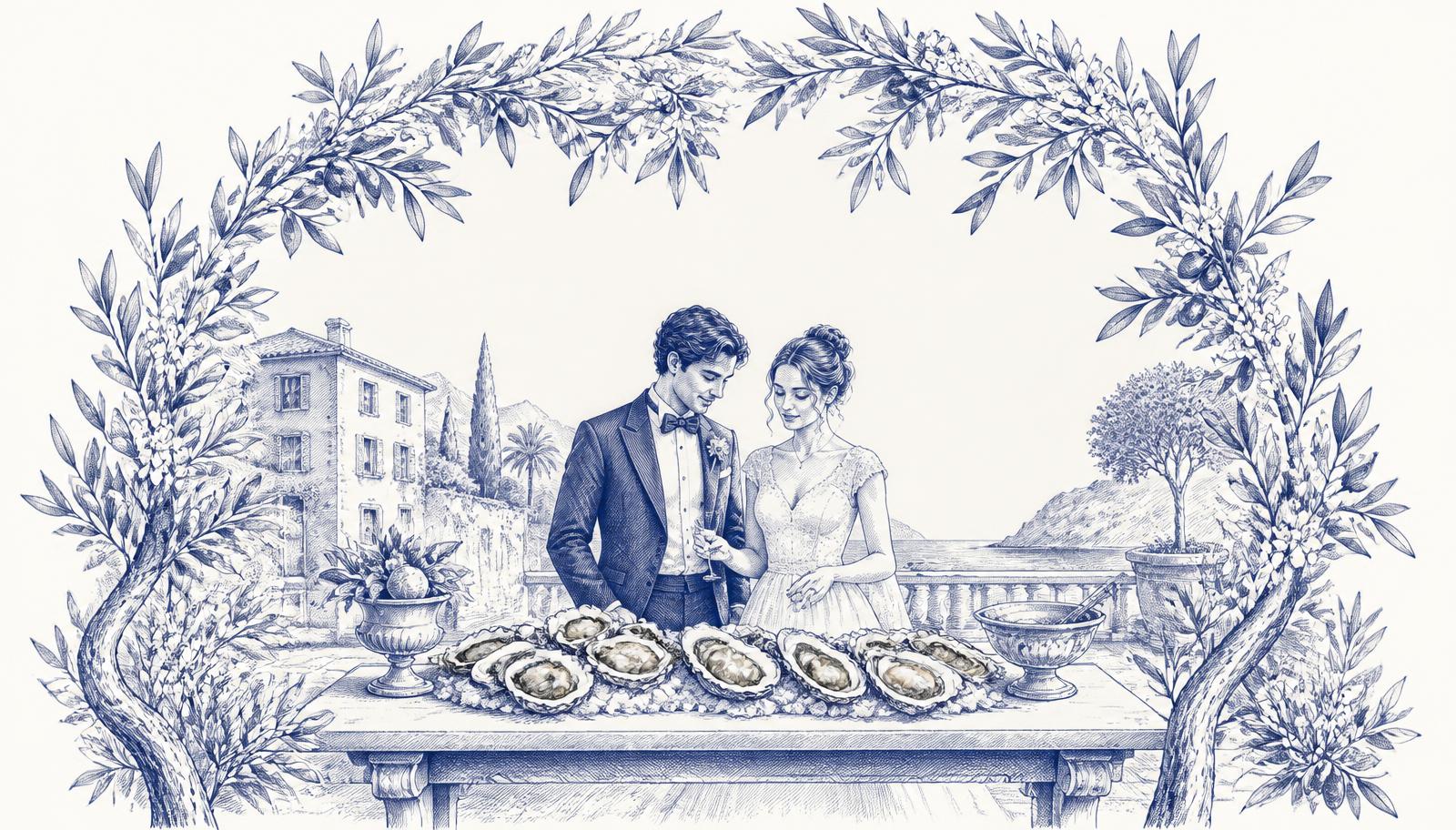
Planning a luxury destination wedding in Mallorca works best when you decide three things early — the format of the day, the part of the island you want to be in, and the month — and then let every other decision follow from those. Venue availability, guest travel, catering structure and the shape of the schedule are all downstream of that trio. Couples who reverse the order, falling for a single property before they know how they want the day to feel, usually spend the following months negotiating against their own choice.
This guide sets out the practical planning logic used for premium weddings on the island: how to compare venue types, how the season affects timing and contingency, how to coordinate a planner and a team of vendors, and where a specialist live seafood moment fits inside a wider menu. THE SEVENTH OYSTER is a specialist live oyster and caviar experience. We are not a wedding planner and not a full-service caterer; we work alongside your planner and your main caterer so that one part of the day is handled by people who do only that. For the wider service context, see our oyster catering in Mallorca guide.
Decide the format before the venue
Mallorca supports several genuinely different wedding formats, and each one implies a different budget structure and a different guest experience. A seated dinner for sixty in a finca courtyard is a different logistical animal from a two-hundred-guest reception across terraces and gardens, which is different again from a two-day celebration built around a private villa.
Ask yourselves what you want guests to remember: a long, slow table; a party that moves through several spaces; or an intimate weekend where the wedding is the centre of a longer stay. The answer determines how much of your budget goes to infrastructure — marquees, generators, additional bathrooms, transport — versus food, drink and design. Large open-air receptions in rural Mallorca often carry significant hidden infrastructure costs that a hotel or a fully equipped estate absorbs internally.
Format also sets the ceiling on how personal the catering can be. Smaller counts allow live, à-la-minute stations and plated tasting sequences. Higher counts push you toward formats that scale predictably, with one or two carefully placed live moments rather than many.
Choosing where on the island
Mallorca is small on a map and slower in practice. Mountain roads in the Serra de Tramuntana are beautiful and narrow; a coach transfer that looks like thirty minutes can take considerably longer with a full guest list and a late departure. Choose an area with the transfer times in mind, not the drone footage.
Broadly, the Tramuntana and its villages give you dramatic elevation, stone architecture and cooler evenings, at the cost of access and delivery constraints. Palma and its immediate surroundings give you accommodation depth, airport proximity and the easiest supplier logistics. The interior — Es Pla, around Sineu, Petra and Santa María — is where most of the classic finca estates are, with space, privacy and long summer light. The east and north coasts offer sea-facing settings but can be exposed to wind and, in peak months, to seasonal traffic.
If a significant share of your guests are flying in for a single night, weight the decision toward accommodation density and short transfers. If the majority are staying a week, you have far more freedom to choose a remote setting.
Season, weather and contingency
May, June, September and early October are the months most premium weddings target, and they are the months that book earliest. July and August are viable but hot: daytime temperatures shape everything from ceremony time to how long food can sit out, and outdoor ceremonies before early evening are uncomfortable for guests in formal dress. Late October and April are increasingly popular and reward you with availability, but need a serious wet-weather plan.
A contingency plan is not a line in a contract; it is a physical space you have seen, with a stated decision deadline. Ask your venue and planner when the call is made, who makes it, and how long the changeover takes. For an outdoor drinks reception, wind matters more than rain — canopies, glassware, ice-based stations and floral installations all behave differently above a certain wind speed.
Heat affects food service directly. Anything served raw or chilled needs shade, a controlled holding temperature and a plan for how long each tray is exposed. This is worth raising with every catering supplier before you sign, not after.
Guest travel and accommodation
Treat guest logistics as part of the design, not admin. Build a simple accommodation list at three price levels within a sensible radius of the venue, and reserve room blocks early for the peak months. Communicate transfer times honestly; guests who understand that the return coach leaves at a fixed hour behave very differently from guests who assume taxis will be available in a rural area at two in the morning.
For a destination wedding, a welcome event the evening before does more work than almost anything else in the weekend. It breaks the ice, absorbs late arrivals and takes pressure off the wedding day itself. It is also the natural place for a relaxed, more experimental food format — often a better home for a live seafood station than the main dinner service.
Ceremony: legal and symbolic
It is worth understanding early that a legally binding marriage in Spain and the ceremony your guests attend are not necessarily the same event. Many international couples complete the legal formalities in their home country or at a civil office, and hold a symbolic ceremony at the venue with an officiant of their choosing — which removes location and timing restrictions from the celebration itself.
Requirements depend on nationality, residency and the type of ceremony, and they do change. Confirm the current position with your planner and with the relevant civil or consular authority well before you commit to dates. Treat any generic online summary — including this one — as orientation only.
Building the team: planner, caterer, specialists
A premium destination wedding is a coordination exercise. On the island, a local planner earns their fee in supplier knowledge, permissions, access constraints and the ability to be physically present when a delivery goes wrong. If you are planning from abroad, this is the first hire, not the last.
The main caterer owns the menu, the service staff, the kitchen infrastructure and the overall food timeline. Specialists — a live oyster and caviar station, a particular pâtisserie, a specific bar programme — sit inside that framework. The distinction matters practically: specialists need to be introduced to the caterer early so that timings, service points, power, water, ice, refuse and staff briefing are agreed rather than improvised.
When you brief a specialist, give them the guest count, the exact window, the service location and its distance from the kitchen, and what is being served immediately before and after. Those five facts determine whether a live station enhances the flow or competes with it. Our guide to choosing an oyster catering service covers the questions worth asking any specialist supplier.
Shaping the schedule
A Mallorcan summer schedule usually pushes later than couples expect. A ceremony at seven, drinks from half past seven, dinner from nine and dancing from eleven is a common and comfortable shape in June or September; a two-o'clock ceremony in August is not. Build the day backwards from sunset, because photography, ceremony light and the temperature curve are all tied to it.
Protect the drinks reception. It is the longest continuous period guests spend together standing and talking, typically ninety minutes, and it is where a destination wedding either feels generous or feels thin. Under-catering this window is the single most common structural mistake.
Leave deliberate gaps. Speeches that run long, a first course that starts fifteen minutes late and a band that needs a soundcheck all consume the same buffer. A schedule with no slack becomes a schedule that is announced over a microphone.
Food and beverage flow
Think in sequences rather than dishes. Guests arrive warm and thirsty; the first fifteen minutes should be about cold drinks and something light. The middle of the reception is where a focal food moment works, once people have a glass in hand and have found each other. The last stretch before dinner should be lighter again, so appetites survive the table.
Coordinate the drinks programme with the food. A live oyster station pairs naturally with dry sparkling wine, a crisp white or a dry sherry; if your bar is built around cocktails, tell the specialist so garnishes and dressings can be adjusted.
Later in the night, a small second wave of food matters more at a destination wedding than at a local one, because guests have often travelled, started early and have no easy way home.
The live oyster and caviar moment
A live oyster bar works best as a defined moment rather than a permanent fixture: a station set up for a specific window, with oysters opened to order in front of guests. It gives the reception a centre of gravity and a natural reason for people to gather and talk, and it photographs well without any staging.
Practically, a station needs a shaded position, a stable surface, reliable access to ice and a clear route for waste. It should sit close enough to the flow of guests to be discovered and far enough from the main bar to avoid a single queue. Caviar service — served simply, with restrained accompaniments — extends the same moment without adding complexity.
Varieties and calibres depend on what the market genuinely offers in a given week, and no responsible supplier should guarantee a specific origin months in advance. What can be agreed in advance is the style of service, the window, the staffing and the standard of presentation. For a deeper look at this format, see our oyster bar for weddings guide and the comparison between an oyster bar and traditional canapés.
Allergens, cold chain and guest care
Molluscs are one of the major declared allergens, and oysters must be clearly identified as such on any menu, sign or briefing. Shellfish allergy can be serious, so the information needs to reach guests before they reach the station, and the service team should be able to answer directly.
Alternatives for guests who do not eat shellfish are part of the main caterer's menu, not the specialist station's — which is another reason to introduce your suppliers to each other early. Confirm who is responsible for collecting dietary requirements and who communicates them to each supplier.
Cold chain is the other non-negotiable. Product should be transported and held chilled, opened to order rather than in advance, and presented on fresh ice with a defined service window. Ask any supplier to describe their handling process in plain language; a clear answer is a good signal.
A planning timeline
Twelve to eighteen months out: agree the format, the season and an approximate guest count. Appoint a local planner. Shortlist and visit venues, ideally at the time of day your event will run.
Nine to twelve months: confirm the venue and the main caterer. Reserve accommodation blocks. Establish the legal versus symbolic ceremony position. Book photography and music, which move fastest for peak dates.
Six to nine months: build the menu structure and decide where specialist moments sit. Brief specialists with guest count, window and location. Confirm transport, and plan the welcome event.
Three to six months: send invitations with honest travel and transfer information. Tasting and menu sign-off. Confirm the wet-weather plan and the decision deadline in writing.
One to three months: final guest count, dietary requirements and seating. Confirm the run sheet with every supplier, including arrival times, access routes and power needs.
Final fortnight: reconfirm quantities, deliveries and the on-site contact for each supplier. Circulate a single timing document to the whole team, and confirm who makes weather calls on the day.
A short planning checklist
Have you seen the wet-weather space in person, and do you know who decides and when? Do you know the real transfer time from your guests' accommodation at the hour they will travel? Is the drinks reception properly catered for its full length? Have your specialist suppliers spoken to your main caterer? Is there shade at every point where guests will stand for more than a few minutes? Are allergens declared where guests will actually read them? Does one written run sheet exist, and does everyone have it?
If you can answer those seven questions confidently, the rest of the planning tends to fall into place.
Planning an oyster moment for your Mallorca wedding
If your wedding is taking shape and you want a live oyster and caviar moment inside it, we are happy to look at your schedule, guest count and venue and tell you honestly what will work in that setting — and what will not. We coordinate directly with your planner and caterer so the moment fits the day instead of interrupting it. Explore our wedding oyster and caviar service or oyster catering in Mallorca, and send us the details for a tailored proposal.
Frequently asked questions
- When should we start planning a wedding in Mallorca?
- For a peak-season date — May, June, September or early October — twelve to eighteen months ahead is realistic, because the strongest venues and suppliers commit early. Shorter timelines are workable outside those months, particularly in April, late October and early November, but expect fewer options rather than lower standards.
- What is the best month for a wedding in Mallorca?
- June and September are the most balanced: long evenings, warm but manageable temperatures and a low chance of rain. July and August are hot enough to reshape the schedule around a late ceremony. April, May and October are lovely and quieter, but need a properly rehearsed wet-weather plan.
- Do we need a local wedding planner?
- If you are planning from abroad, effectively yes. A local planner knows the venues' real constraints, holds the supplier relationships, handles permissions and access, and can be physically present when something needs solving on the day. It is the hire that protects every other decision.
- Can we get legally married in Mallorca?
- Requirements depend on nationality, residency and the ceremony type, and they change. Many international couples complete the legal formalities at home and hold a symbolic ceremony on the island. Confirm the current position with your planner and the relevant civil or consular authority before fixing dates.
- How does an oyster bar fit into a wedding reception?
- Best as a defined window during the drinks reception, with a station in a shaded spot, oysters opened to order and a clear service period agreed with the main caterer. It gives guests a reason to gather without competing with the wider canapé service or delaying dinner.
- Are oysters safe to serve outdoors in the Mallorcan summer?
- They can be served well outdoors when the station is shaded, product is held chilled, oysters are opened to order rather than in advance, and the service window is defined in advance rather than left open-ended. Ask any supplier to explain their handling process before you book.
- What about guests with a shellfish allergy?
- Molluscs are a declared allergen and must be clearly identified on menus and at the station. Alternative dishes are part of the main caterer's menu, so dietary requirements should be collected centrally and shared with every supplier well before the day.
- Can you guarantee specific oyster varieties?
- No responsible supplier can guarantee a particular origin or calibre months in advance, because availability depends on the market at the time. What can be agreed in advance is the service format, the window, the staffing and the presentation standard.
Planning an oyster experience in Mallorca
The Seventh Oyster creates tailored oyster and caviar experiences for weddings, private villas and celebrations, coordinating directly with planners, venues and main caterers. Share the date, the location, an approximate guest count and the concept — we will build a proposal shaped around it.