Elegant Food Stations for Luxury Weddings in Mallorca
How to design and coordinate food stations at a luxury Mallorca wedding: how many, where to place them, how guests move between them, and where a specialist live oyster and caviar station belongs.
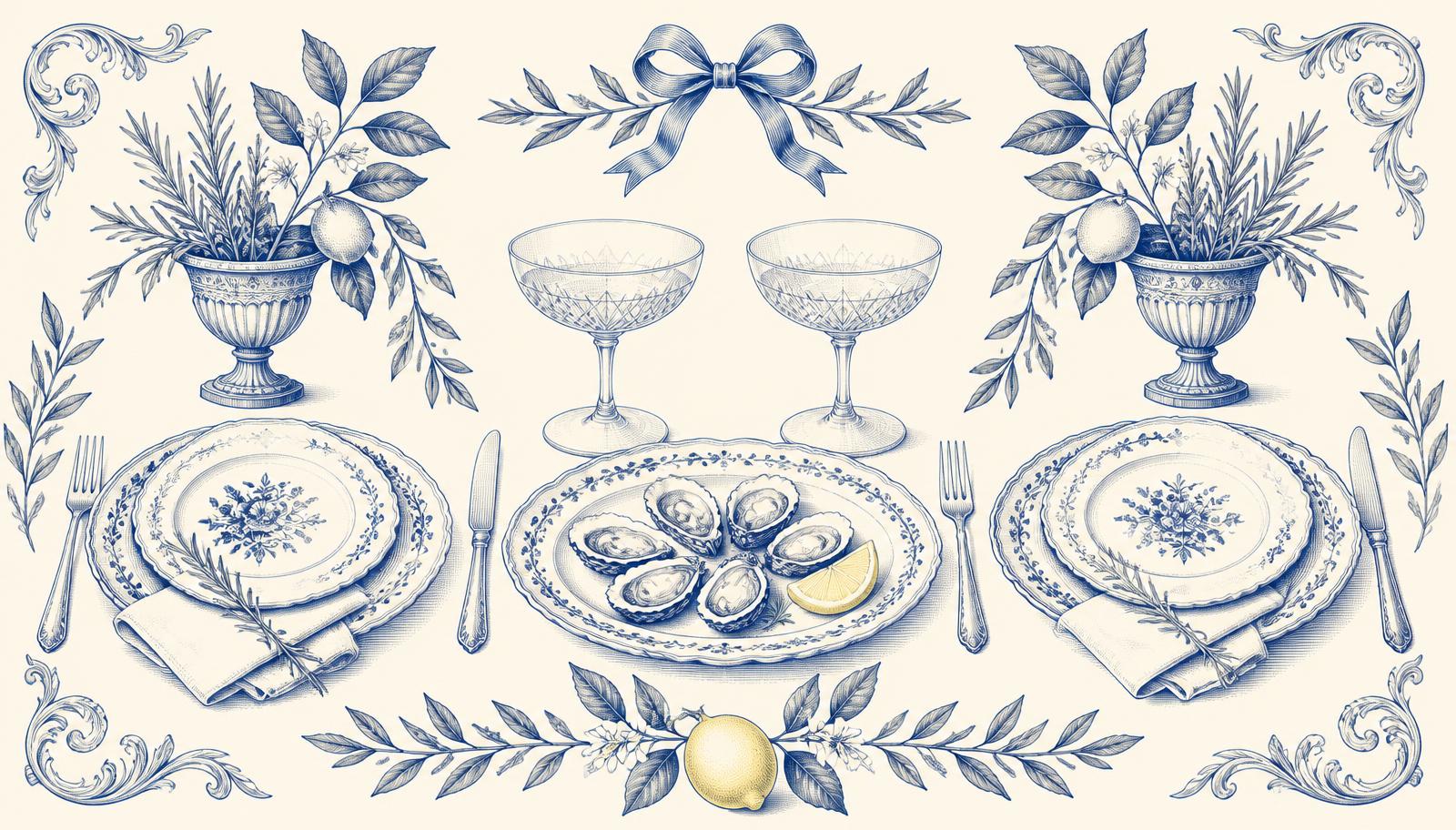
A food station is a fixed serving point where food is finished, plated or opened in front of guests, rather than carried to them on trays or served at a seated table. At a luxury Mallorca wedding, stations work best during welcome drinks and the cocktail hour: they give guests somewhere to move towards, they turn preparation into something worth watching, and they take pressure off the passed-canape service without pre-empting dinner.
This guide covers the planning logic behind stations rather than an inspiration list: how many to run, where to place them, how to keep guests moving, what the Mallorcan climate demands of an outdoor setup, and how a specialist station sits inside a menu delivered by your main caterer. THE SEVENTH OYSTER is a specialist live oyster and caviar station. We are not a full-service caterer and not a planner; we coordinate with both. For the wider service picture, read our oyster catering in Mallorca guide.
Stations, canapes, buffets and plated dinner: the real differences
Passed canapes bring a fixed selection to a standing guest. They are efficient, they reach everyone, and they require nothing of the guest. Their limit is that they are anonymous: the food arrives already made, and the moment leaves no impression beyond taste.
A buffet is a self-service line where guests assemble a plate from prepared dishes. It scales well and costs less per head in service terms, but it produces queues, it looks best in the first ten minutes, and it rarely reads as luxury at a wedding.
A plated dinner is the controlled, seated centre of the day. Courses arrive in sequence, timing is in the kitchen's hands, and the room stays together.
A station is none of those. It is staffed, it is small in range, and its point is that something is finished in front of the guest: oysters opened, a dish carved, a garnish added to order. It should offer one thing done precisely, not a whole menu. That distinction is what keeps stations feeling elegant instead of turning the reception into a market.
Why stations belong to the cocktail hour
The gap between the ceremony and dinner is the least structured part of a wedding. Guests who have just travelled, sat through a ceremony and found a drink need somewhere to go and something to talk about. Stations give the space a shape: they create natural gathering points, they spread guests across a terrace or garden instead of compressing them at the bar, and they let people who do not know each other stand side by side with a reason to speak.
Strategically, a station also protects the dinner. A short, defined station window means guests arrive at the table interested rather than full. That is a planning decision, not a catering one: the window has to be agreed with the planner and the main caterer, and it has to end on time.
Stations also solve the arrival problem at villa weddings, where guests trickle in over half an hour. A visible, staffed point of interest absorbs early arrivals far better than an empty lawn.
How many stations, and where
For most weddings, two or three stations across the cocktail hour is the working range, alongside passed canapes and the bar. One station can become a bottleneck; four or more starts to look like a food court and fragments the room. The right number depends less on guest count than on the number of distinct spaces you are trying to activate.
Place stations so that the guest journey makes sense. Guests should meet a drink first, then discover the food, and never be forced to cross a service route or the ceremony strike-down to reach it. Keep stations out of the direct line between the bar and the seating, or the two queues will merge.
Distance matters. Two stations placed within a few metres of each other create one crowd and one queue; the same two placed at opposite ends of a terrace pull guests through the space and keep both busy. Give every station a clear approach side and a clear exit side so people do not double back into the people behind them.
Sightlines are part of the design. A live station earns its place by being watched, so it should be visible from the main gathering area but not positioned where it blocks the view that made you choose the venue.
Guest flow and queue prevention
Queues at a wedding are almost always a layout problem rather than a speed problem. The most common causes are a single approach point, no landing space for the finished item, and guests who have nowhere to stand once served.
Design each station with a serve side and a step-away side. Give guests somewhere to put a glass down while they eat, or accept that anything requiring two hands will slow the line. Cocktail tables placed a few metres beyond a station do more for flow than extra staff at the station itself.
Stagger opening times rather than starting everything at once. If one station opens as guests arrive and a second opens ten or fifteen minutes later, the crowd redistributes itself without anyone being asked to move.
Finally, define an end. Every station should have an agreed service window, communicated to the planner and the venue, so that the transition to dinner is clean and nobody is left holding a plate as they are seated.
Mallorca specifics: heat, shade and weather backup
From late spring to early autumn, an outdoor Mallorcan reception in the late afternoon is warm, bright and often exposed. Any station handling chilled or raw product must be under genuine shade for the whole service window, not shade as it exists at the moment of the site visit. Track where the sun will actually be at your ceremony-to-dinner hour, and plan for the light moving.
Wind matters more than most couples expect, particularly on coastal terraces and in the Serra de Tramuntana. Linens, menu cards, light garnishes and umbrellas all need weighting or securing.
Every outdoor station needs a defined wet-weather or extreme-heat alternative agreed in advance: a covered terrace, an interior room or a marquee position, with the same access, shade and power. A backup that exists only in conversation is not a backup.
Utilities are frequently the constraint at rural fincas and private villas. Confirm power access and load, whether a generator is involved and who is sharing it, water access for the preparation area, and ice delivery and storage. Ask the venue where waste and shells leave the property, and by which route, so that a service path does not cross the guest area mid-reception.
Preparation zones, lighting and accessibility
The visible station is only half of the footprint. Behind it there needs to be a discreet preparation and holding zone, close enough to resupply quickly and hidden enough that guests never see boxes, cool boxes or waste. If the venue has no back-of-house near the reception area, the station position has to be chosen around that.
Lighting is what separates a station that works at seven o'clock from one that disappears at nine. Plan for the light dropping: focused, warm light on the working surface keeps the ritual visible and the product looking as it should. Avoid harsh downlights that flatten everything and coloured uplighting on food.
Accessibility should be checked in physical terms: a stable, level approach without steps or loose gravel, a serving height that works for a seated guest, and enough clear width for two people to pass behind someone being served. On historic properties this often decides the position on its own.
Building a coherent mix without turning the reception into a market
The failure mode of station-led weddings is variety for its own sake. Guests do not need six choices in forty-five minutes; they need two or three that feel deliberate and that do not repeat one another in temperature, texture or richness.
As a planning framework rather than a shopping list, most stations fall into a small number of categories: a chilled or raw seafood station; a live-prepared hot station; a Mediterranean produce station built around local vegetables, olive oil and bread; a cheese and charcuterie station; a dessert station; and a drinks or cocktail station. Your main caterer will normally deliver these general categories as part of the wider menu, and it is their menu that should decide the balance.
A useful test: if two stations could plausibly serve the same canape, one of them is redundant. Contrast is what makes the sequence read as a designed progression rather than an assortment.
Above all, stations should not replace the dinner. They set up the meal, they do not compete with it. Keep portions small, keep the range narrow, and keep the window short.
Where a live oyster and caviar station fits
A specialist live oyster and caviar station occupies a narrow, well-defined role: one high-quality chilled element, opened to order, within the wider reception. It works because it is genuinely live — the shell is opened, checked and handed over in front of the guest — and because it demands nothing of the rest of the kitchen.
In practice, that means coordinating with three parties. The main caterer decides where the station sits in the menu so it does not duplicate their own seafood offering. The planner owns the timeline, the service window and the guest journey. The venue confirms position, shade, power, water, ice and waste routes. THE SEVENTH OYSTER works within those decisions rather than around them; we bring the station, the team and the product for that one component, and nothing else.
For a deeper look at how the service itself is run, see live oyster shucking for events and our oyster bar for weddings in Mallorca article. If you are still deciding between formats, oyster bar or traditional canapes compares the two directly.
When an oyster and caviar station adds value, and when it may not
It adds value when the reception is standing and social, when there is a defined cocktail hour rather than a rushed transition, when shade and a preparation zone are available, and when the couple genuinely want a produce-led, live moment rather than a decorative one. It also adds value when the main menu is otherwise warm and rich, because a chilled raw element resets the palate.
It may not suit the brief when the reception is very short and already crowded with service, when there is no viable shaded position or utility access, when a significant share of the guest list does not eat shellfish, or when the couple's priority for that part of the day is something else entirely. A specialist who tells you the format does not fit your brief is more useful than one who agrees to everything.
Alternatives for guests are a menu question, and therefore the main caterer's responsibility. What a specialist station should do is flag the need early: confirm with your planner that the passed canapes and other stations give non-shellfish guests something of equivalent quality at the same moment, so nobody stands at the edge of a gathering point with nothing to eat.
Operational discipline for raw oysters
Raw shellfish outdoors in a Mediterranean summer is a discipline, not an improvisation. The things to insist on, from any supplier, are these: a controlled cold chain from source to service, with the product kept refrigerated in transit and correctly held on site rather than sitting out; a shaded station position for the whole service window; opening close to the moment of service, to order, rather than a tray of pre-opened shells held on ice; and every oyster checked individually as it is opened, with anything doubtful discarded.
Traceability should be documentable: oysters from approved suppliers, with the accompanying documentation retained, so the batch served at your wedding can be identified after the event.
Molluscs are a declarable allergen. That has to be communicated clearly at the station and reflected in the information your caterer and planner hold, alongside a note that the station handles raw shellfish. No responsible supplier can guarantee the absence of trace cross-contact in a shared event environment, and none should promise it. What can be committed to is the handling standard, the service format and the communication.
The same honesty applies to product: varieties, calibres and origins depend on the market at the time and cannot be guaranteed months ahead. The service format, staffing and presentation standard can be.
A decision checklist
Before confirming a station plan, work through the following with your planner. What is the exact service window, and what ends it? How many stations, and which distinct space does each one activate? Where does each station sit relative to the bar, the seating and the ceremony space? Is there real shade for the whole window, and what is the wet-weather or extreme-heat position? Where is the discreet preparation and holding zone? What are the power, water, ice and waste arrangements, and who supplies each? How will the station be lit as daylight goes? Is the approach level and wide enough for every guest? Which supplier is responsible for each station, and who owns the running order between them? How are allergens captured, communicated and covered by alternatives on the main menu?
If any of those questions has no owner, that is the first thing to fix.
A sample sequencing framework
Without inventing timings that only your planner can set, a workable structure looks like this. Guests arrive and are met with a drink and passed canapes only, so nothing competes with arrival. Shortly after, the first station opens in the main gathering area, giving early arrivals a focal point. A second station opens once most guests have arrived, positioned away from the first so the crowd divides naturally. The specialist live station runs within its own agreed window inside this period, with the end time fixed in the timeline. Stations then close in sequence, staff clear discreetly, and the transition to dinner happens with the space already emptying in the right direction.
The principle is simple: stagger the openings, define the closings, and never let two focal points sit in the same corner.
Planning your station
If a live oyster and caviar station is the right fit for your wedding, the useful next step is a conversation about your venue, your timeline and the rest of your menu, so the format is designed around your day rather than dropped into it. We work alongside your planner and your main caterer, and we are happy to say when the format is not the right call.
Tell us the date, the venue and roughly how the reception is structured, and we will come back with a tailored proposal. Start with our wedding oyster and caviar service page, or get in touch directly.
Frequently asked questions
- What is a food station at a wedding?
- A staffed serving point where one type of food is finished, plated or opened in front of guests, rather than passed on trays or served at a seated table. Its defining feature is that preparation is visible and made to order.
- How many food stations should a luxury wedding have?
- Two or three across the cocktail hour is the usual working range alongside passed canapes and the bar. The number should follow the spaces you want to activate; four or more tends to fragment the reception and create competing queues.
- Do food stations replace the wedding dinner?
- They should not. Stations belong to welcome drinks and the cocktail hour, with small portions and a defined end time, so guests arrive at dinner interested rather than full.
- Can food stations work outdoors in the Mallorcan summer?
- Yes, with genuine shade for the whole service window, secured setups against wind, confirmed power, water and ice, and an agreed covered alternative for rain or extreme heat. Chilled and raw stations need those conditions as a precondition, not an upgrade.
- How do you stop queues forming at a station?
- Give each station a clear approach and exit side, place cocktail tables a few metres beyond it, keep stations away from the bar-to-seating route, and stagger opening times so the crowd redistributes itself.
- Where does an oyster bar fit among the other stations?
- As the chilled, raw component of the reception, positioned in shade and running inside its own agreed window. It should not duplicate any seafood already on the main caterer's menu.
- Does THE SEVENTH OYSTER provide all the wedding food stations?
- No. We are a specialist live oyster and caviar station only. The wider menu, including any other stations, is delivered by your main caterer, and we coordinate with them, your planner and the venue.
- What about guests with a shellfish allergy?
- Molluscs are a declarable allergen and must be clearly communicated at the station and in the information your planner and caterer hold. Alternatives sit within the main caterer's menu, so allergies should be collected centrally and shared with every supplier in advance.
- Can specific oyster varieties be guaranteed for our date?
- No responsible supplier can guarantee variety, calibre or origin months in advance, because availability depends on the market. The service format, staffing, timing and presentation standard can be agreed and committed to.
Planning an oyster experience in Mallorca
The Seventh Oyster creates tailored oyster and caviar experiences for weddings, private villas and celebrations, coordinating directly with planners, venues and main caterers. Share the date, the location, an approximate guest count and the concept — we will build a proposal shaped around it.